thanks, did some asking around and tada found it.
also found out why no one knew about it.
when spun properly, an amazing frequency cycle happens-
THE BULLROARER
Since there are no bull-like animals in Australia, this is a misnomer for the Aboriginal instrument, but the actual word used is "secret-sacred" and not shared with non-Aboriginal people. The instrument itself consists of a simple wooden slat, 30 to 40cm in length and 5 to 7cm wide that is whirled around in a circle on the end of a length of cord. The slat rotates under the influence of aerodynamic forces and generates a pulsating sound with a frequency typically around 80Hz. This sound is an important feature of Aboriginal initiation ceremonies.
Not tubes, but a flat dealio, I remembered it as a tube, m'eh peyote..
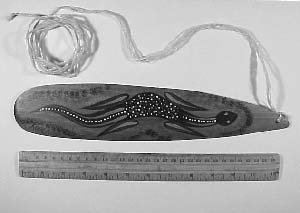
The instrument itself is by no means unique to Australia, and similar sound generators have been used by populations as diverse as those of ancient Egypt and the Inuit of Northern Canada. An Australian instrument is shown in Fig. 2.
The aerodynamics of sound generation in the bullroarer has been described in detail elsewhere [6], and only an outline will be given here. Since the quasi-static aerodynamic forces and torques on the slat balance out over a single period of its revolution, the aerodynamic torque driving its rotation depends upon the rate of rotation itself. There is one rotation-inducing torque term that is linear in slat rotation speed, and also a drag term proportional to the square of the rotation speed, These lead to a threshold rotation rate that must be exceeded to begin the process, and then to an upper limit to the rotation rate. The steady angular rotation rate f of a rectangular slat of width W swung through the air on a string of length L with rotation frequency F can be shown to be approximately
f = 1.1 LF/ W - 5 ,
where f and F are in rotations per second. Each rotation of the slat creates an oscillating flow dipole and, from considerations of symmetry, the dipole oscillation frequency, and thus the radiated sound frequency, is 2f. The radiated acoustic power P is approximately
P = 3 (p/c3) H2V6
where H is the length of the slat, p is the density of air, c is the speed of sound in air, and V=2πLF is the speed of the slat through the air. From these two equations we see that wide slats produce sound of lower frequency but that the radiated power is independent of slat width. Sound frequency is, however, proportional to airspeed and thus to arm rotation rate, and the radiated power is a strong function of this arm rate. For typical conditions, the radiated power is a few milliwatts for an arm rotation rate of 120 r.p.m., which is about as fast as can normally be achieved. Sound radiation is nearly omnidirectional.
Because the output power is a strong function of airspeed V, and the arm rotation is normally faster on the down-sweep than on the up, the sound pulsates with a frequency typically between 1 and 2Hz. There is an additional slower pulsation with a period of several seconds that derives from the fact that the slat rotation gradually twists the cord, providing a contrary torque which eventually stops the rotation and re-launches it in the opposite sense.
Figure 3. (a) The pressure waveform of sound from a bullroarer, showing typical pulsations. (b) Frequency analysis of this sound, showing low harmonic development.
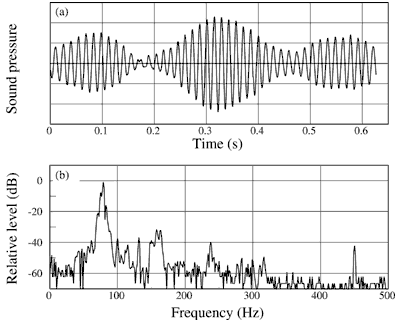
Analysis of the sound, as in Fig. 3, shows little harmonic development, the second-harmonic peak being about -30dB relative to the fundamental. The peaks are, however, somewhat broadened because of the variable rotational speed of a human arm.
Bullroarers have accompanied the didgeridoos in initiation ceremonies and in burials to ward off evil spirits, bad tidings, and even women and children.
